← All demos · TB · 19 screens · example data
Real tariffs, bill check, demand charges and tax benefits
Pick the customer's real rate, prove it on last month's bill, show demand savings apart, and add depreciation to payback
Pick the real rate
TB01
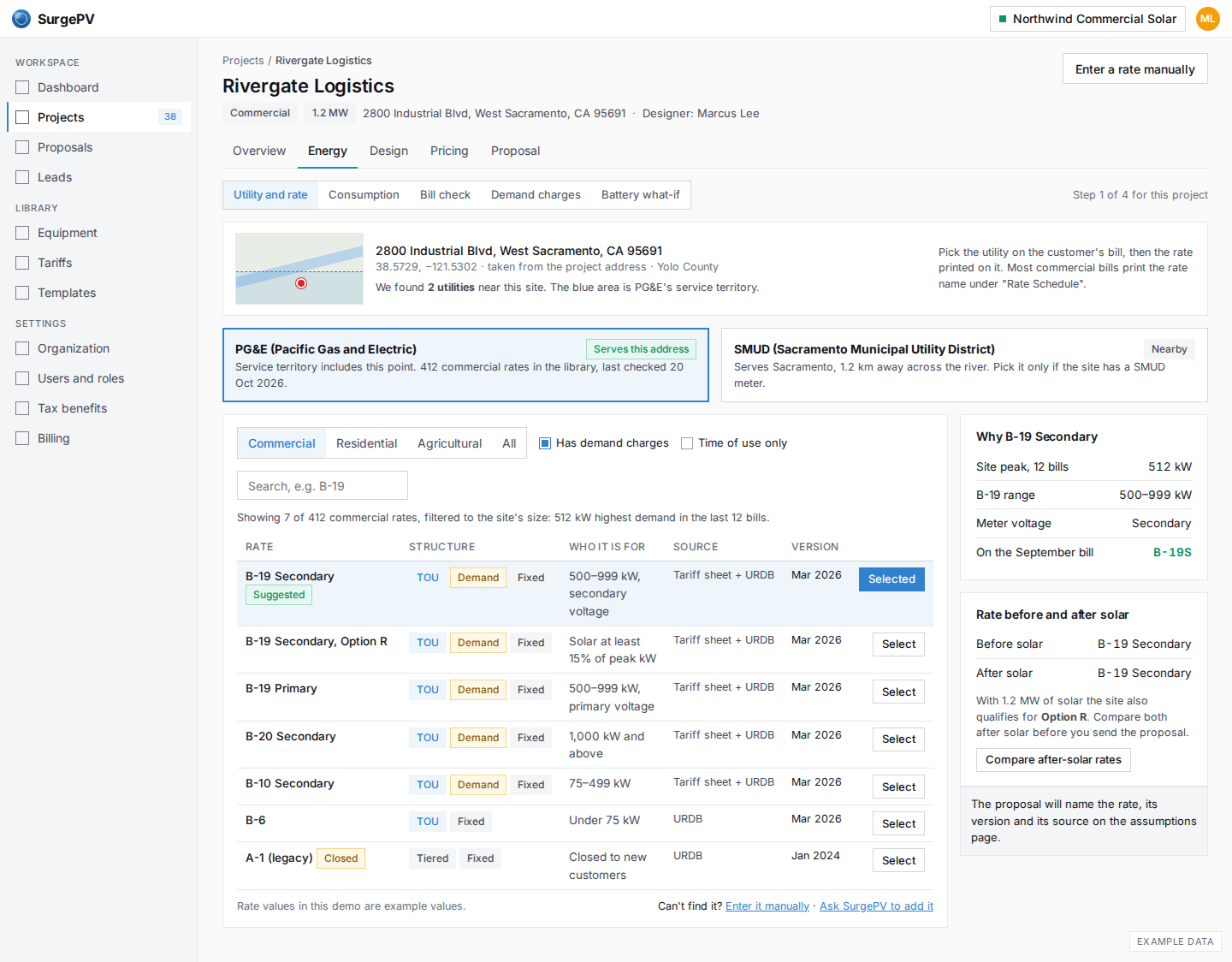
The rate from the site address
SurgePV finds the utilities for the site address: PG&E serves it, SMUD is nearby. It lists PG&E's commercial rates with structure badges, source and version, and suggests B-19 Secondary from the site's 512 kW peak.
TB02
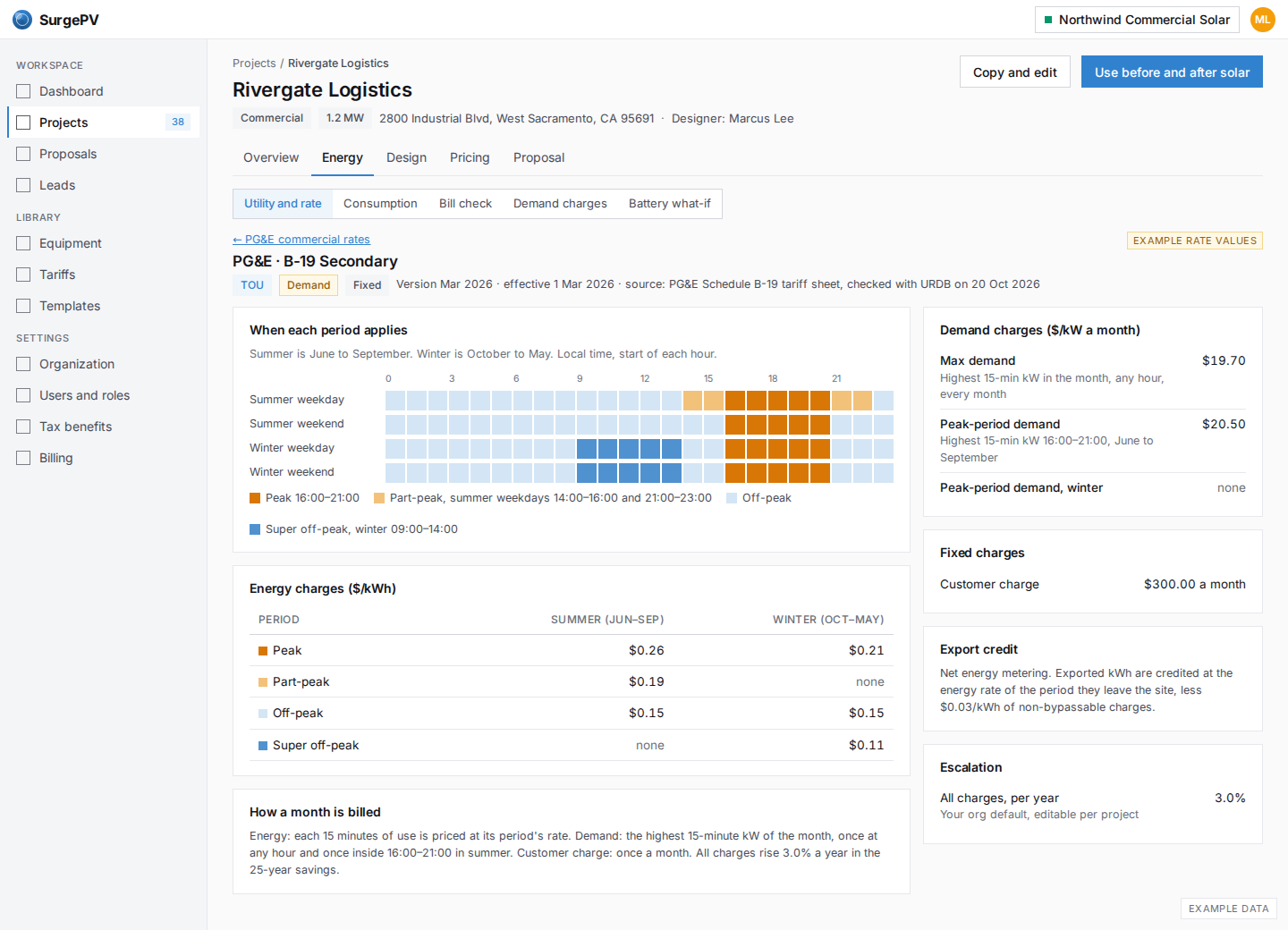
Rate detail: PG&E B-19 Secondary
The whole rate on one page: when each period applies in summer and winter, energy $/kWh, the two demand charges in $/kW, the customer charge, the export rule and the yearly escalation, with the version and source.
Prove it with last month's bill
TB03
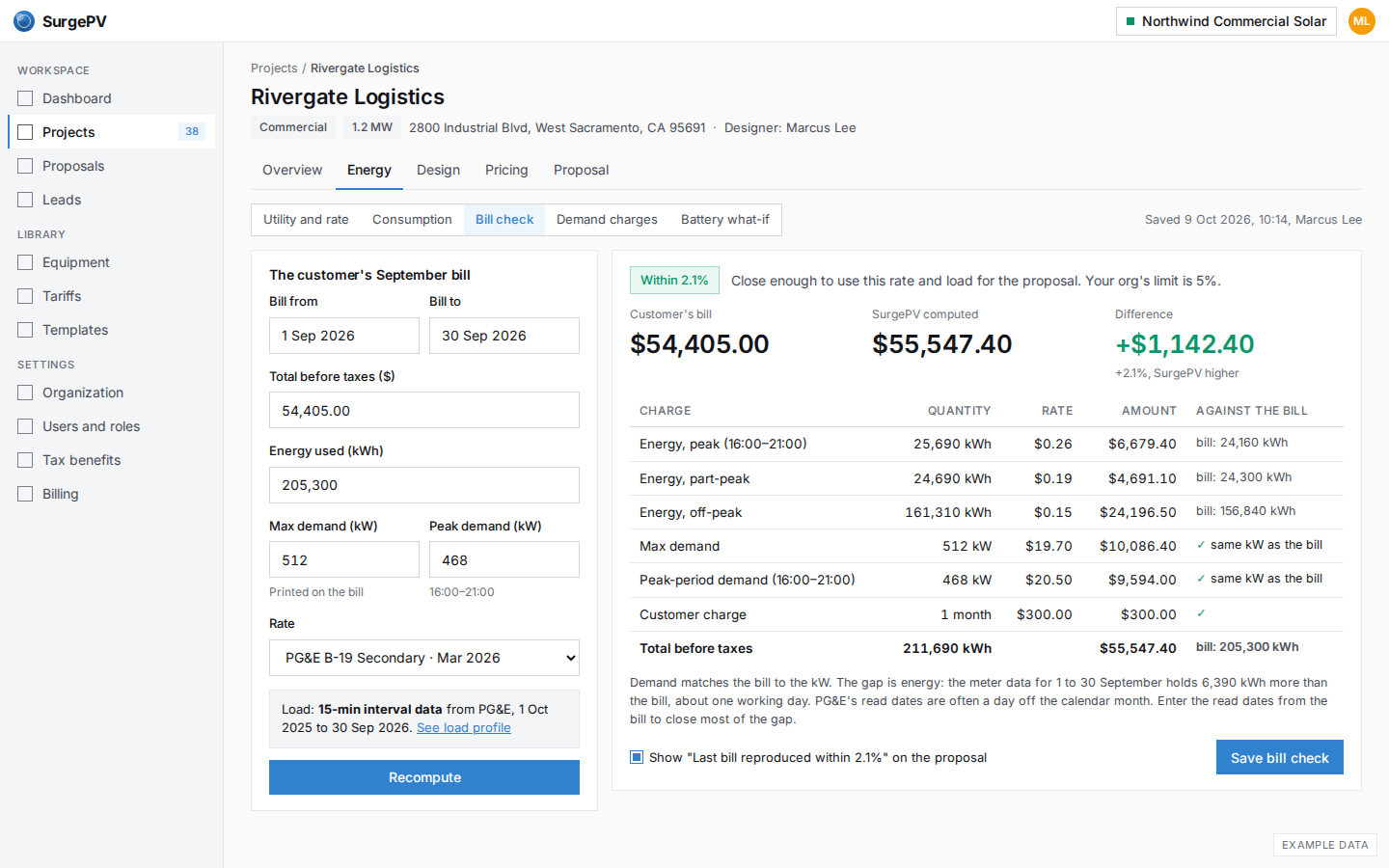
September bill reproduced within 2.1%
Type in last month's bill and SurgePV rebuilds it line by line on B-19: $55,547.40 against the real $54,405.00, within 2.1%. Demand matches the bill to the kW; the small gap is in energy and the screen says why.
TB04
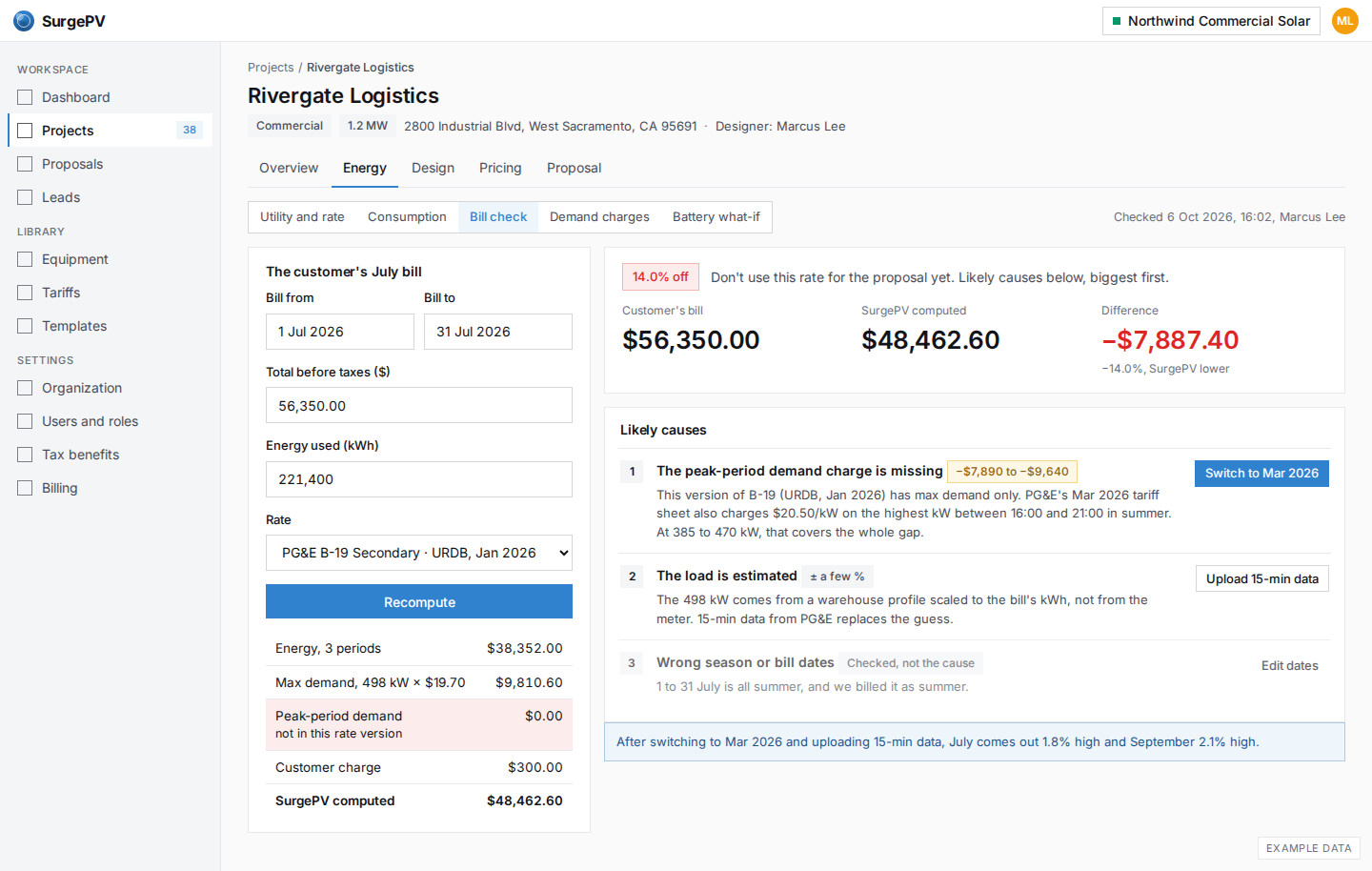
July bill 14% off: what is missing
When the copy of a bill is far off, SurgePV says so and ranks the likely causes with their dollar size. Here the rate version from the US rate database lacks B-19's peak-period demand charge; one click switches to the tariff-sheet version.
Load: why demand needs 15-min data
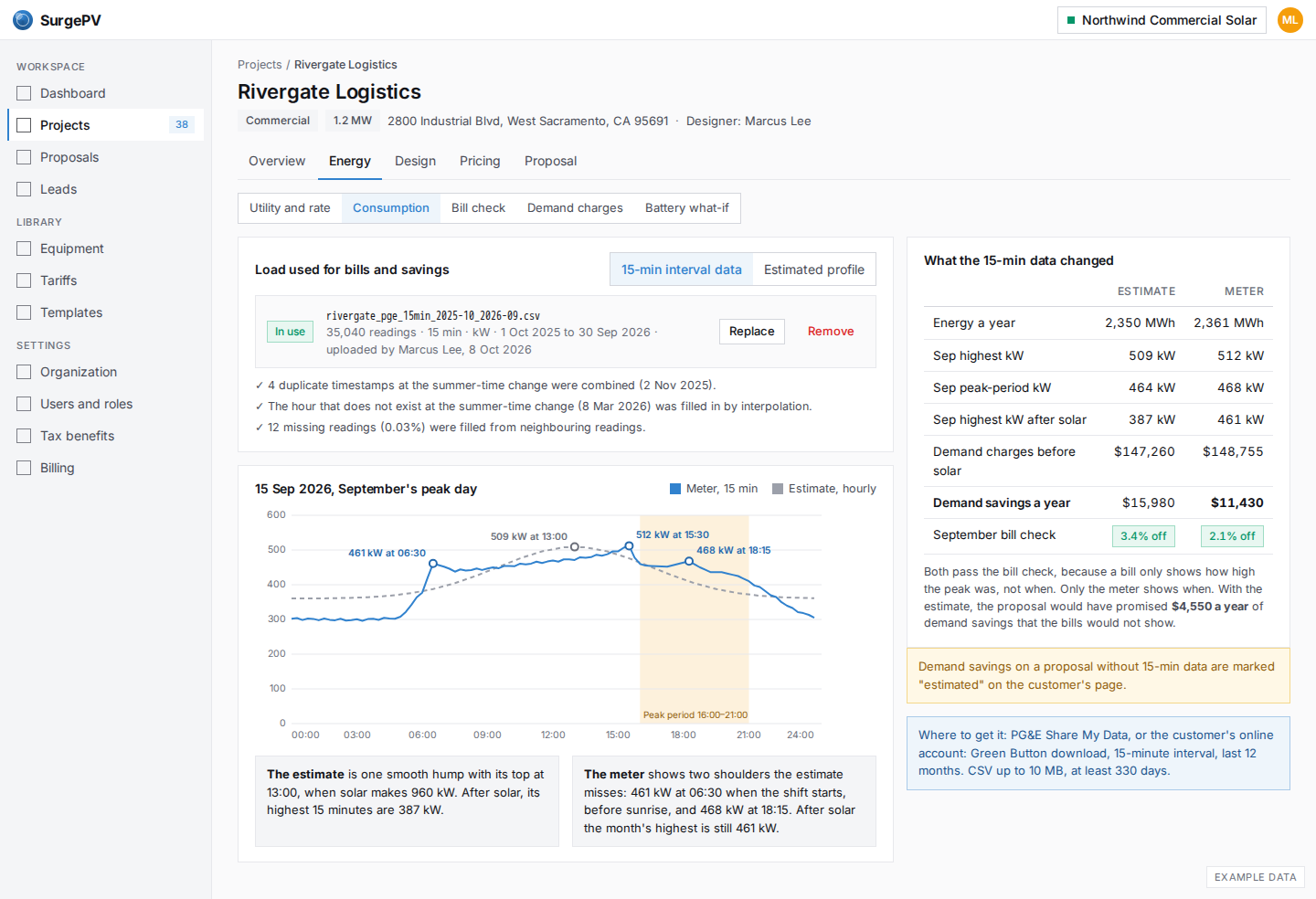
Savings the owner believes
TB06
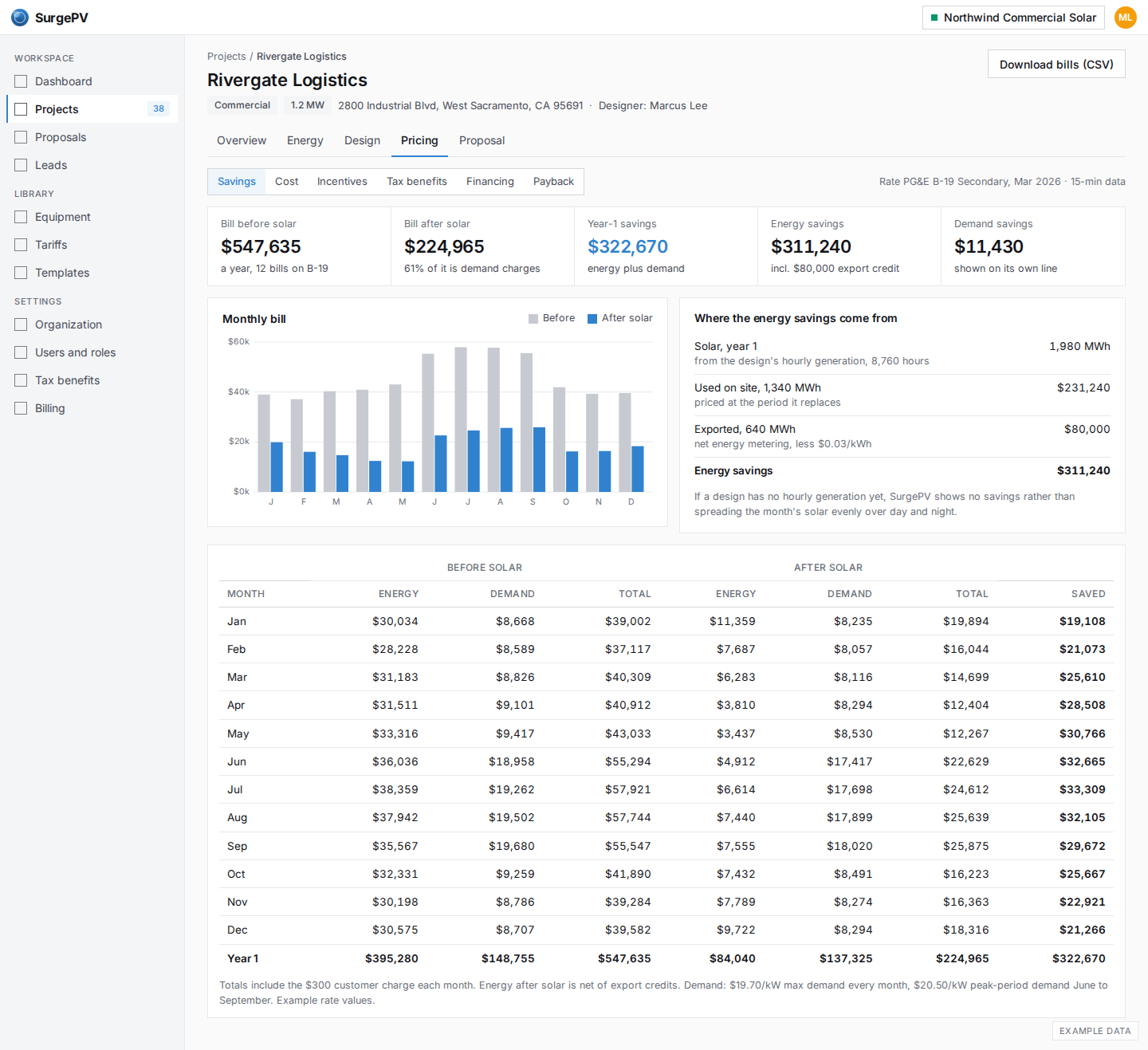
Year-1 savings: energy and demand apart
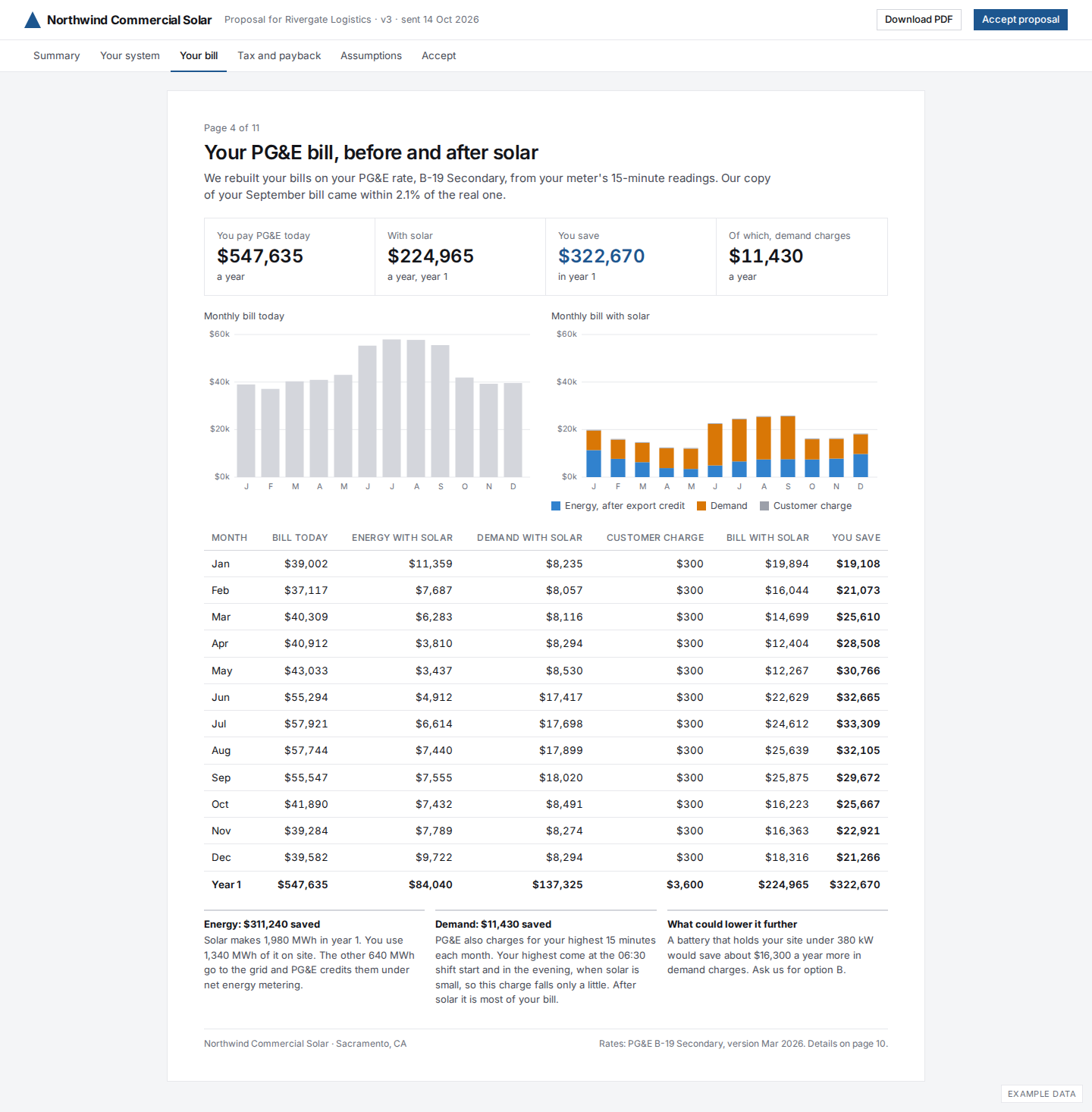
Twelve rebuilt bills before and after solar. Year-1 savings of $322,670 split into energy ($311,240, including export credits) and demand ($11,430). After solar, 61% of the bill is demand charges.
TB07
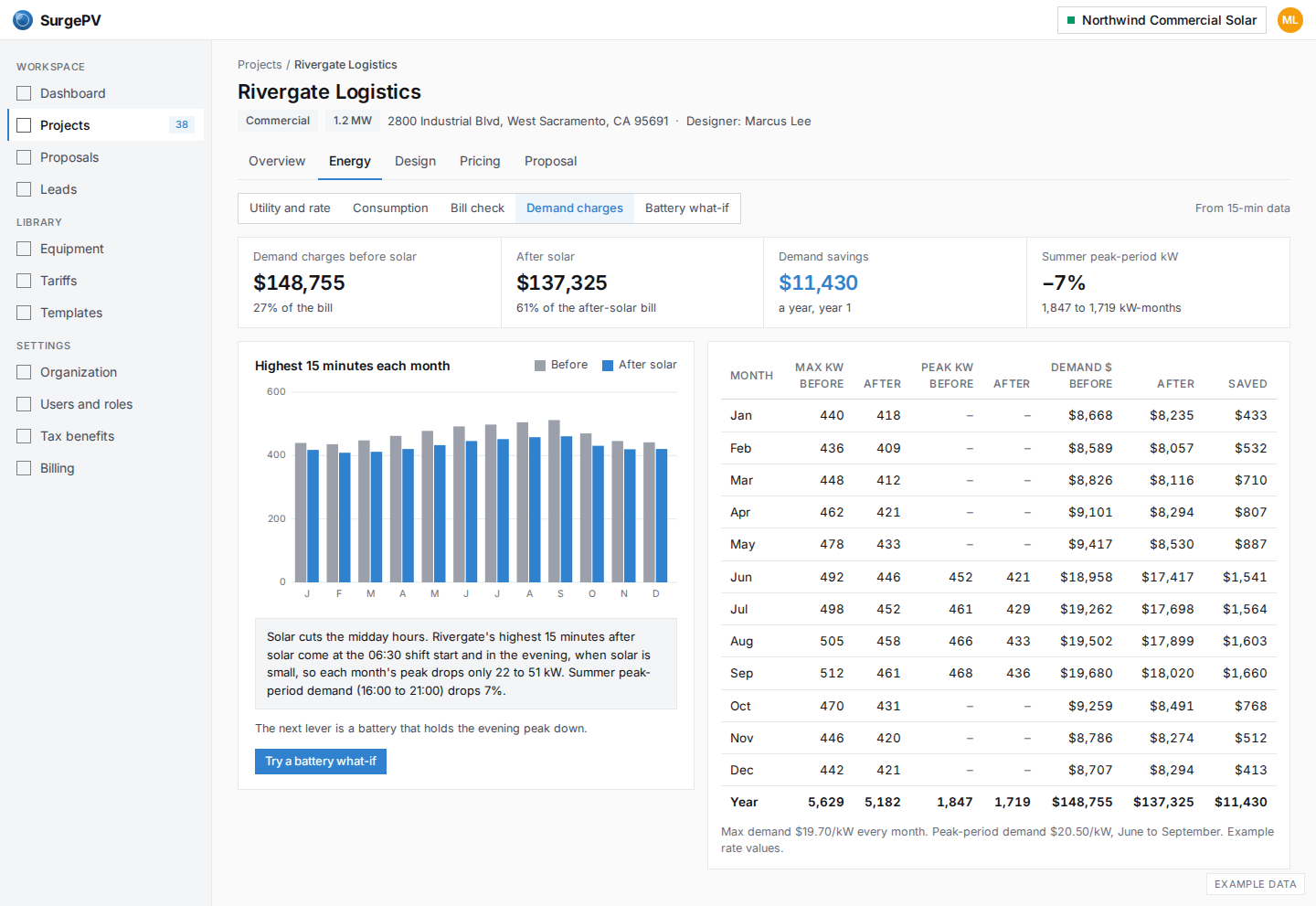
Monthly peak before and after solar
Each month's highest 15 minutes before and after solar, and the demand charge it sets. Solar takes 22 to 51 kW off the monthly peak because Rivergate's peaks come when solar is small.
TB08
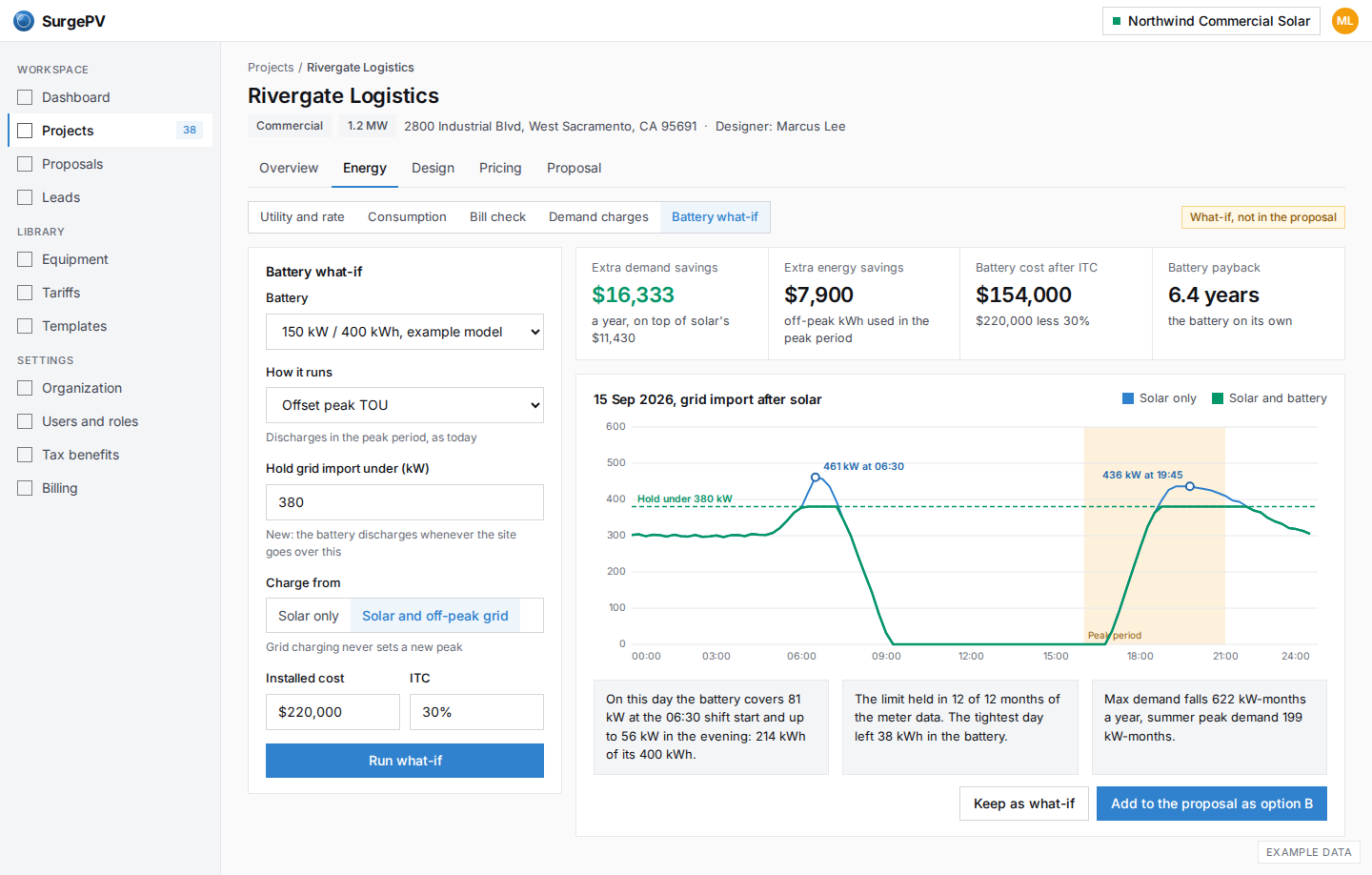
Battery what-if: hold the evening peak
A what-if, kept out of the proposal: a 150 kW / 400 kWh battery that holds grid import under 380 kW saves $16,333 a year more in demand charges and pays back in 6.4 years on its own. One click adds it as option B.
Tax benefits
The proposal the owner reads
TB10
Proposal page: your bill before and after
What Rivergate's facilities lead reads: the PG&E bill today and with solar, month by month, with demand charges on their own line and a plain note on why solar lowers them only a little.
TB11
Proposal pages: tax, payback, assumptions
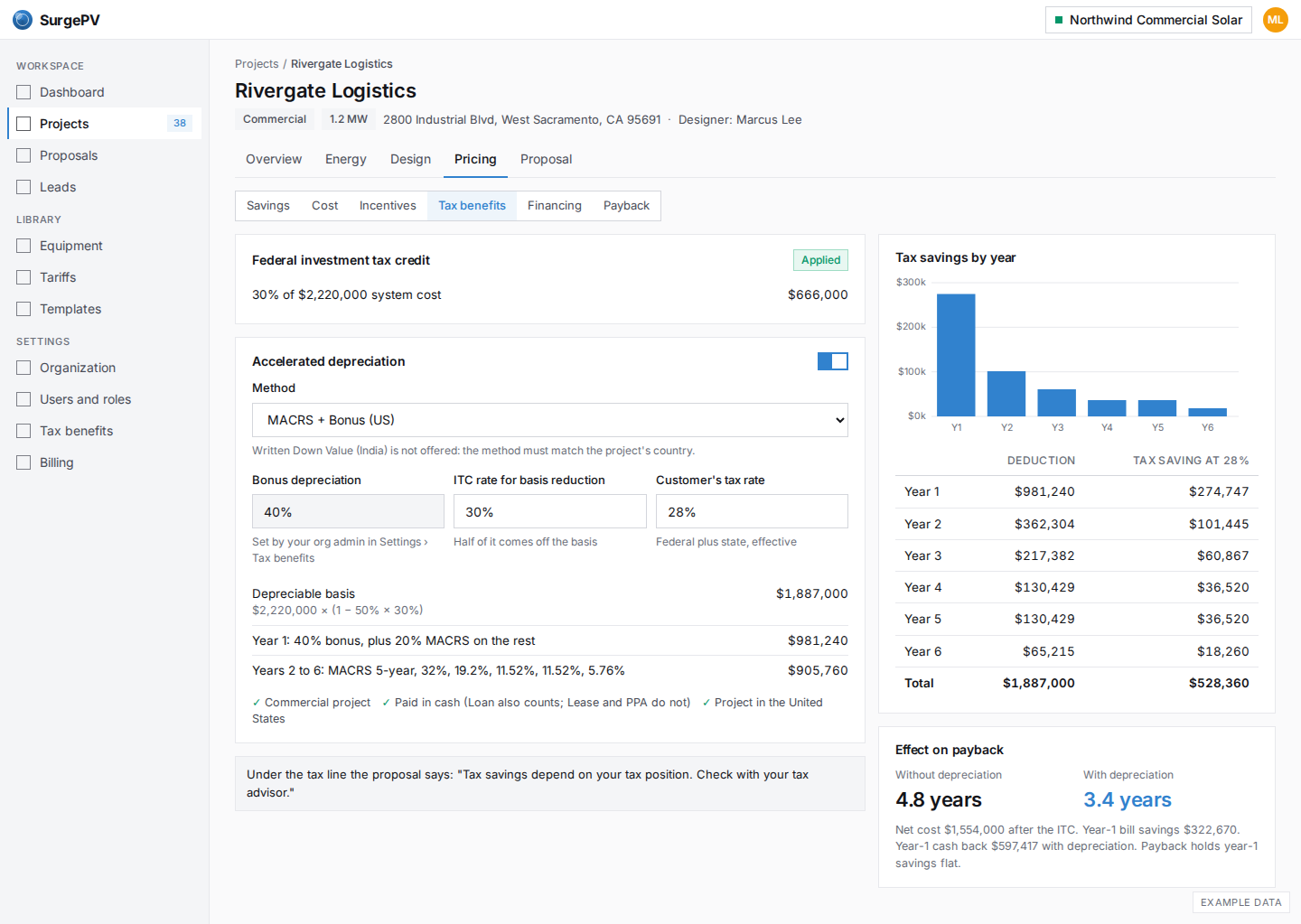
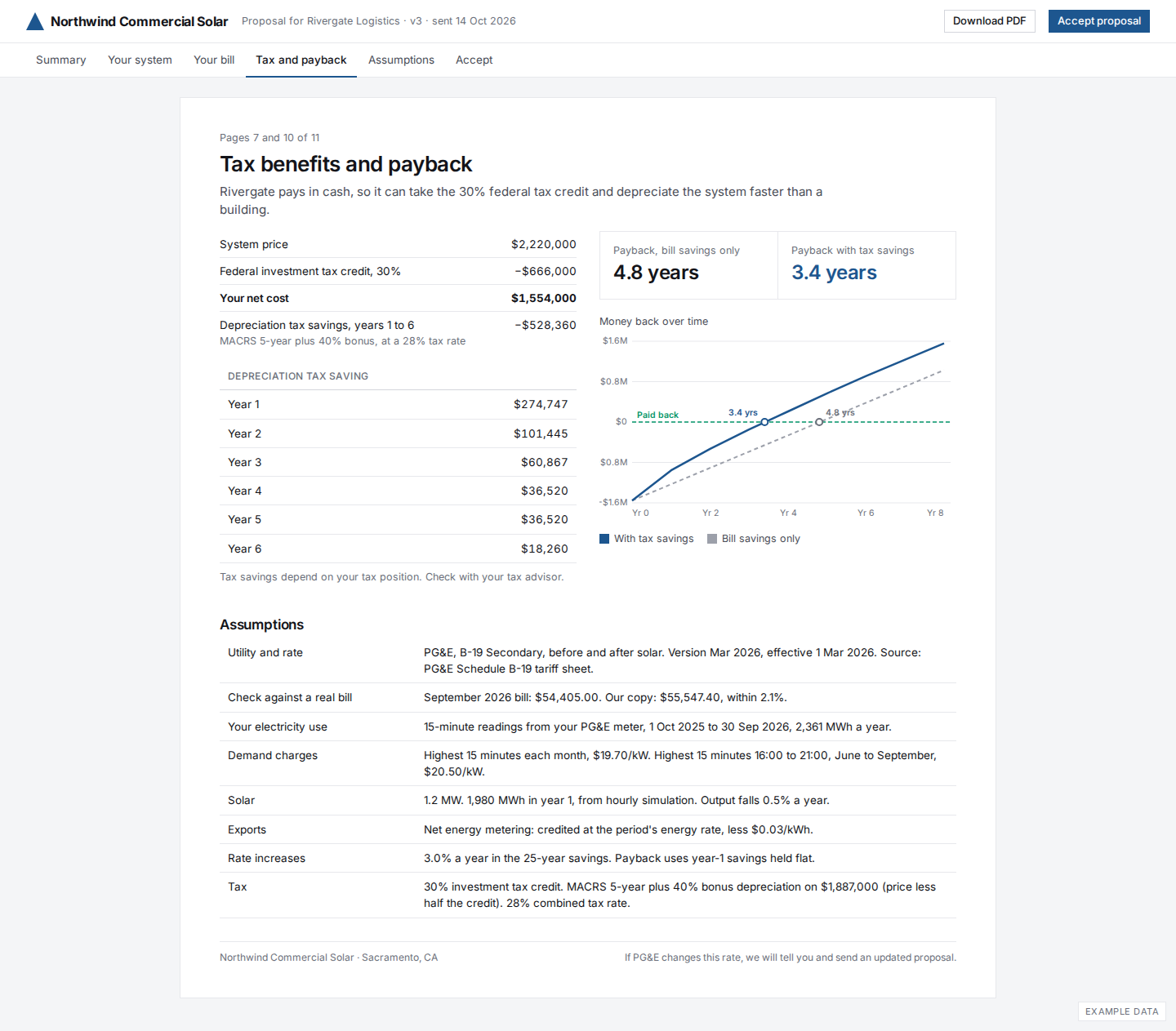
The tax page: ITC, depreciation by year and payback with and without tax savings, with the tax-advisor line. Below it, every assumption, including the rate's version and source and the bill check.
TB12
Phone: the owner opens the proposal
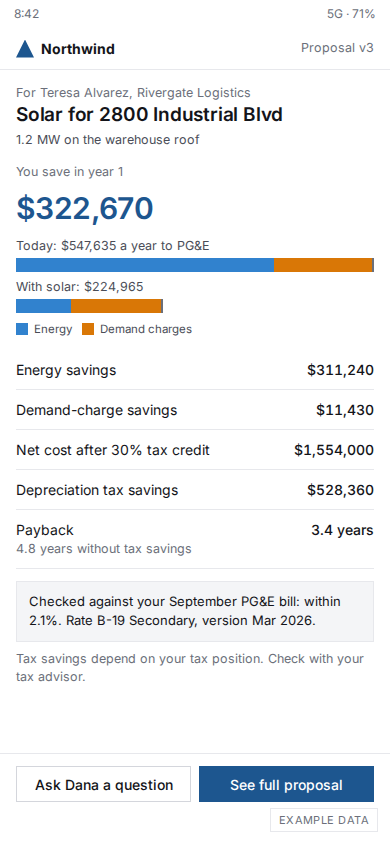
The same proposal on the owner's phone: year-1 savings, today's bill and the bill with solar, demand savings, tax savings and payback, and the bill check in one line.
When something is off
TB13
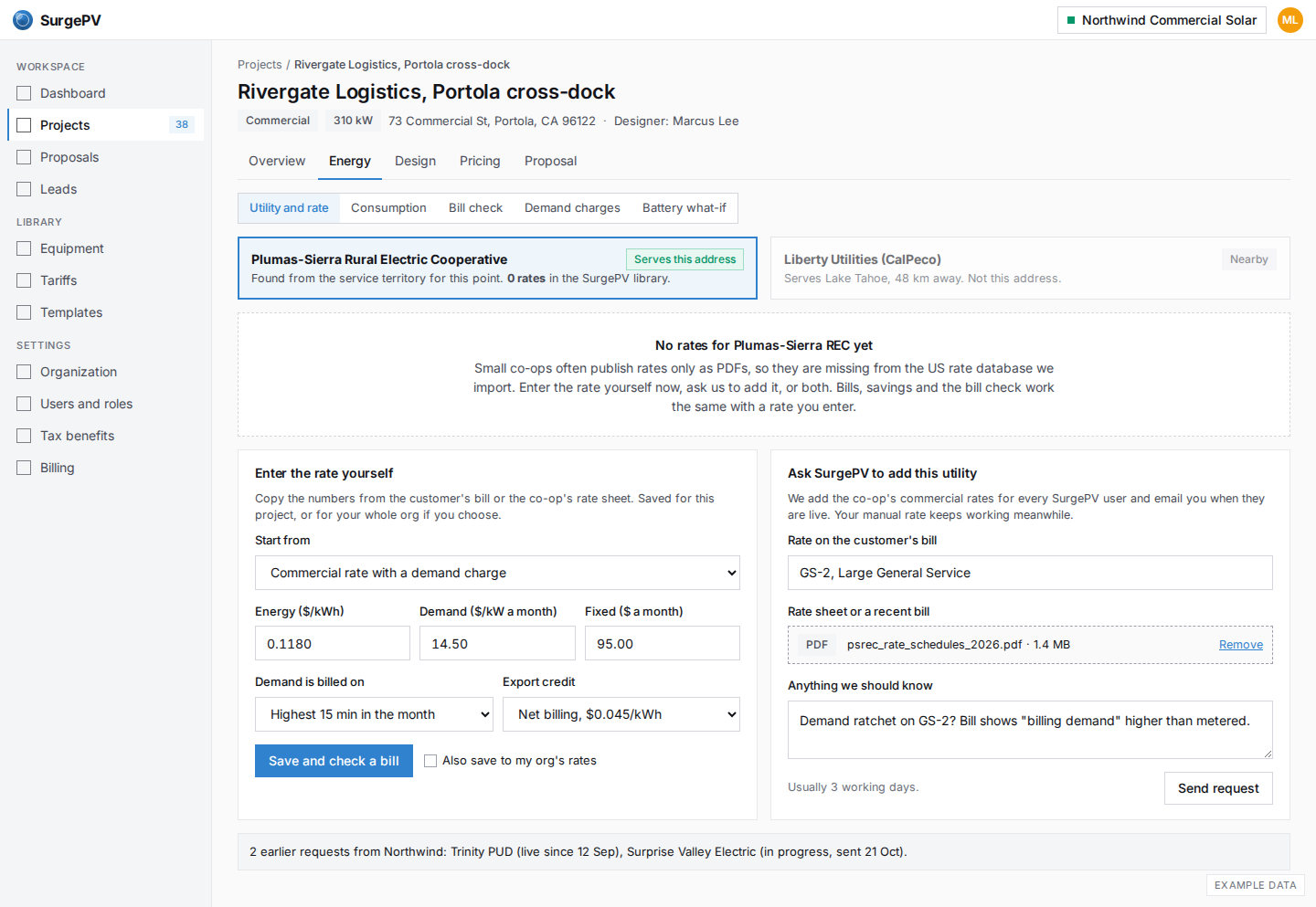
No rate for a small co-op
A second Rivergate site in Portola is served by Plumas-Sierra REC, which has no rates in the library. The designer can enter the rate with a demand charge now, and send the rate sheet so SurgePV adds the co-op for everyone.
TB14
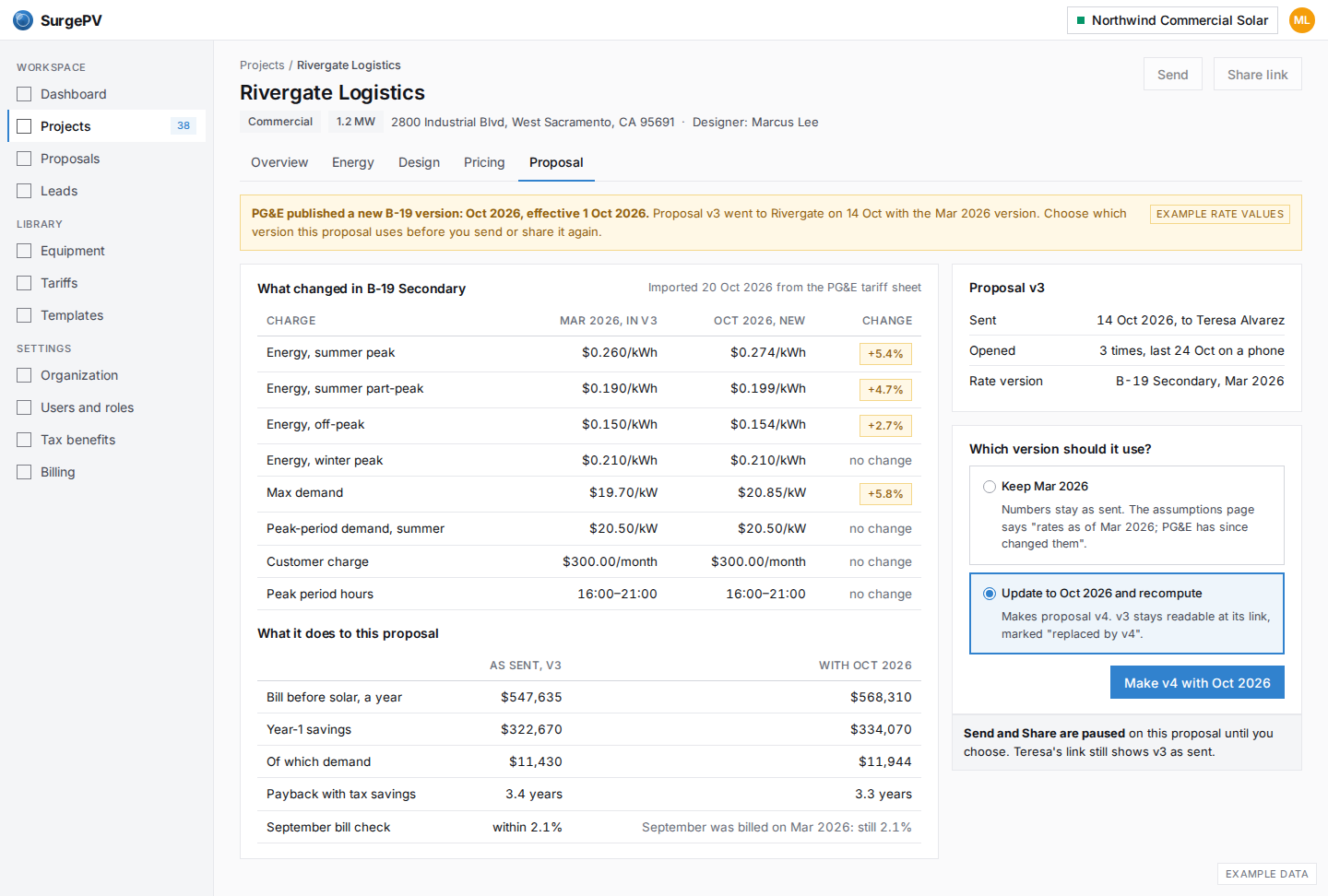
The rate changed after the proposal was sent
PG&E's Oct 2026 B-19 arrived after proposal v3 went out on the Mar 2026 version. SurgePV shows what changed and what it does to savings and payback, and pauses Send and Share until the designer keeps the old version or makes v4.
TB15
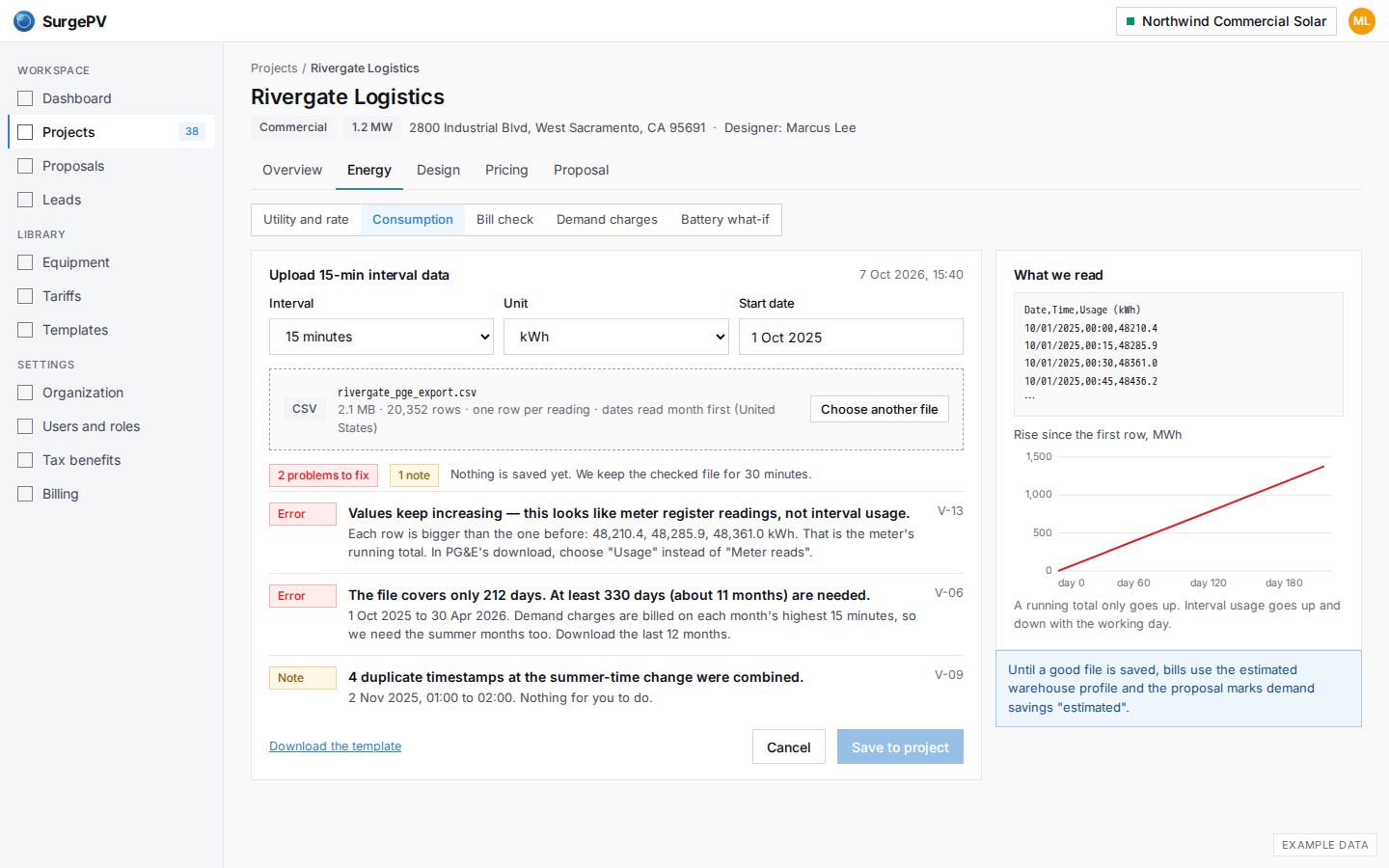
Uploaded CSV with errors
The first PG&E file was the wrong export: meter register readings, and only 212 days. SurgePV lists every problem at once in plain words, says how to get the right file, and saves nothing until it is fixed.
Same feature, other markets
TB16
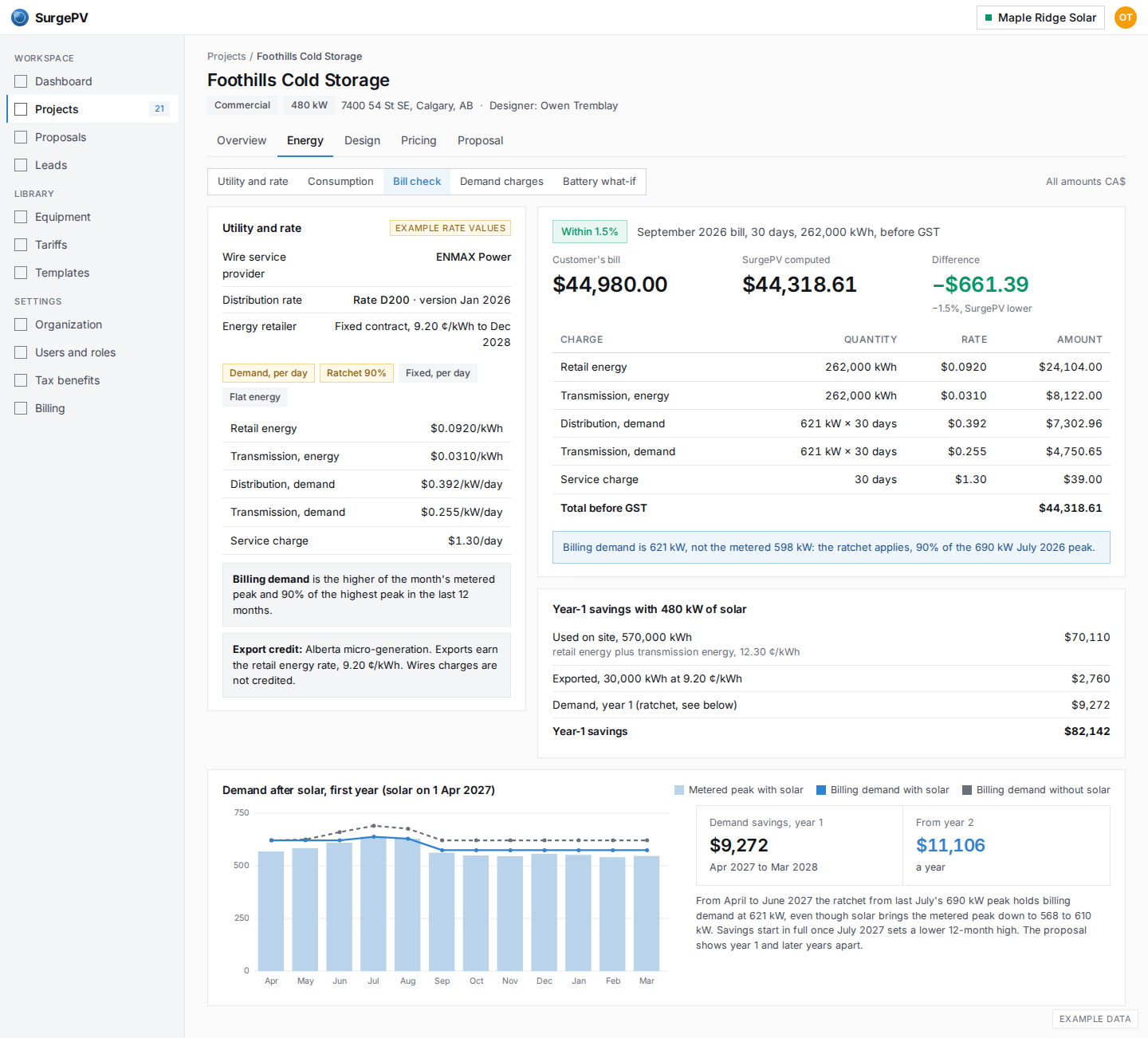
Calgary: ENMAX D200 with ratchet
Foothills Cold Storage in Calgary (CA$). Alberta splits the wire owner from the retailer, bills demand per kW per day and applies a 90% ratchet. The bill reproduces within 1.5%, and the ratchet holds year-1 demand savings to CA$9,272 against CA$11,106 from year 2.
TB17
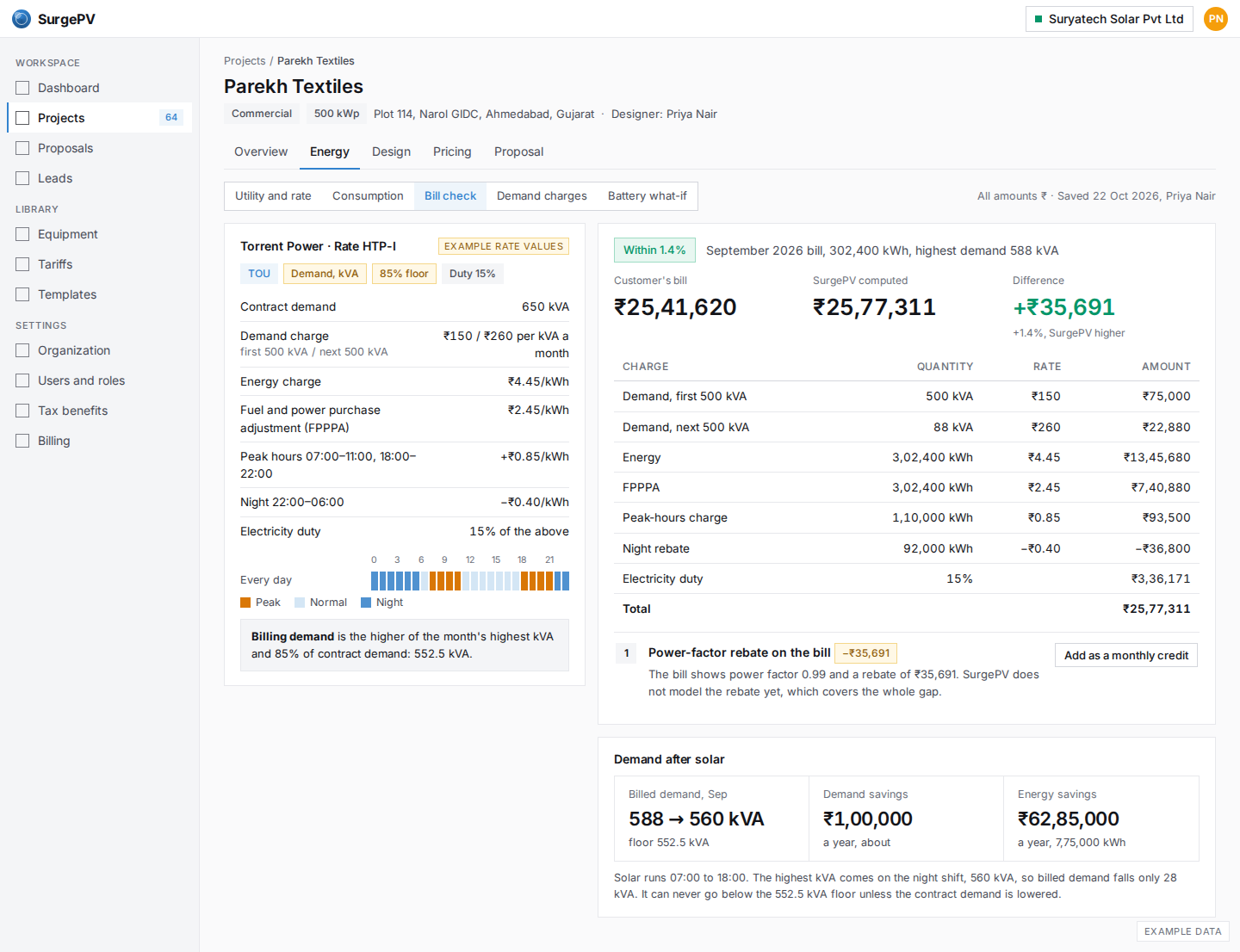
India: Torrent Power HT with kVA demand
Parekh Textiles on Torrent Power HTP-I. Demand is billed in kVA with an 85% contract-demand floor, plus FPPPA, peak-hour charge, night rebate and 15% duty. The bill reproduces within 1.4%; the gap is the power-factor rebate.
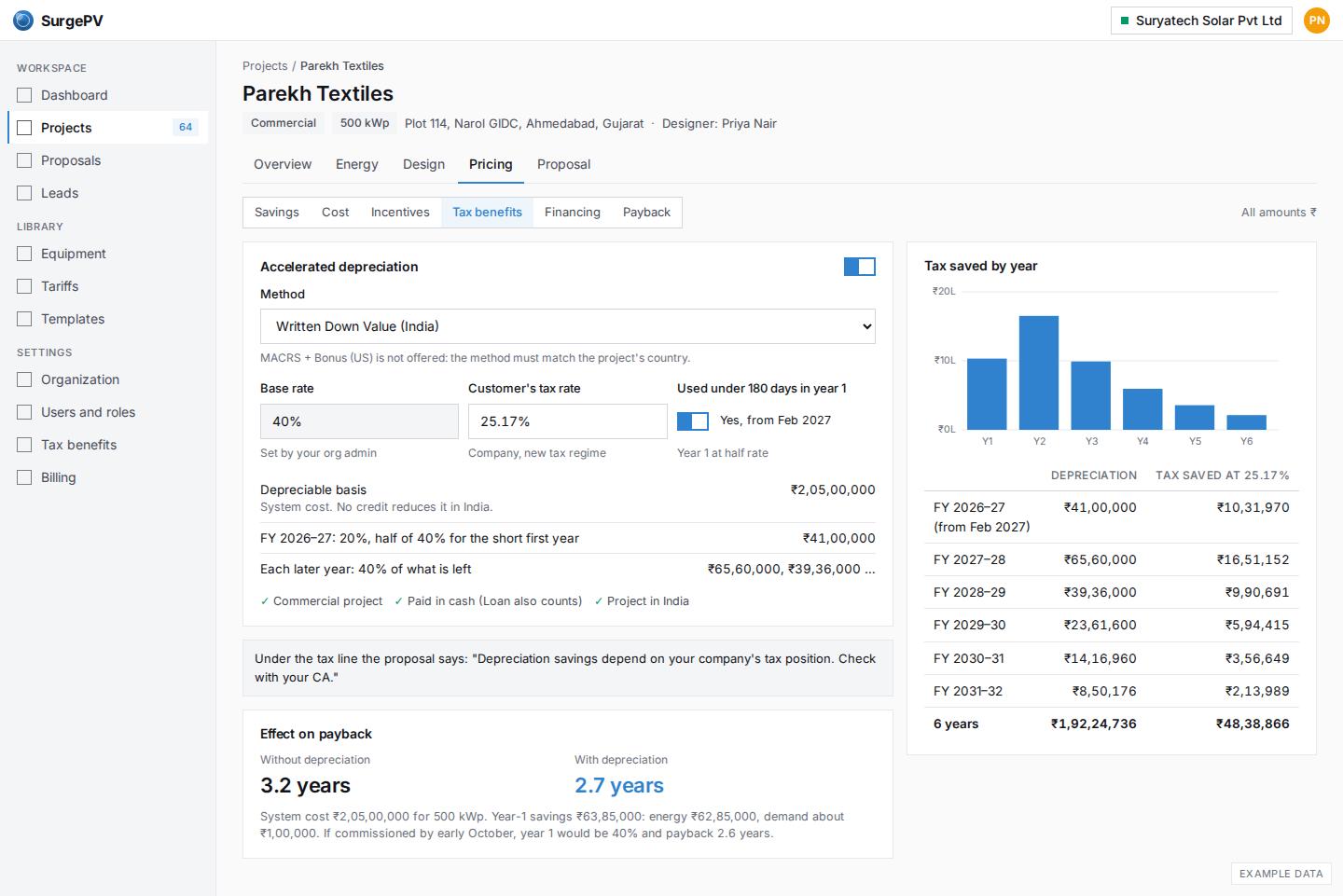
TB18
India: 40% WDV depreciation and payback
The same Tax benefits panel for an Indian company: 40% written-down value, half rate in year 1 because commissioning is in February, at 25.17% tax. Payback goes from 3.2 to 2.7 years.
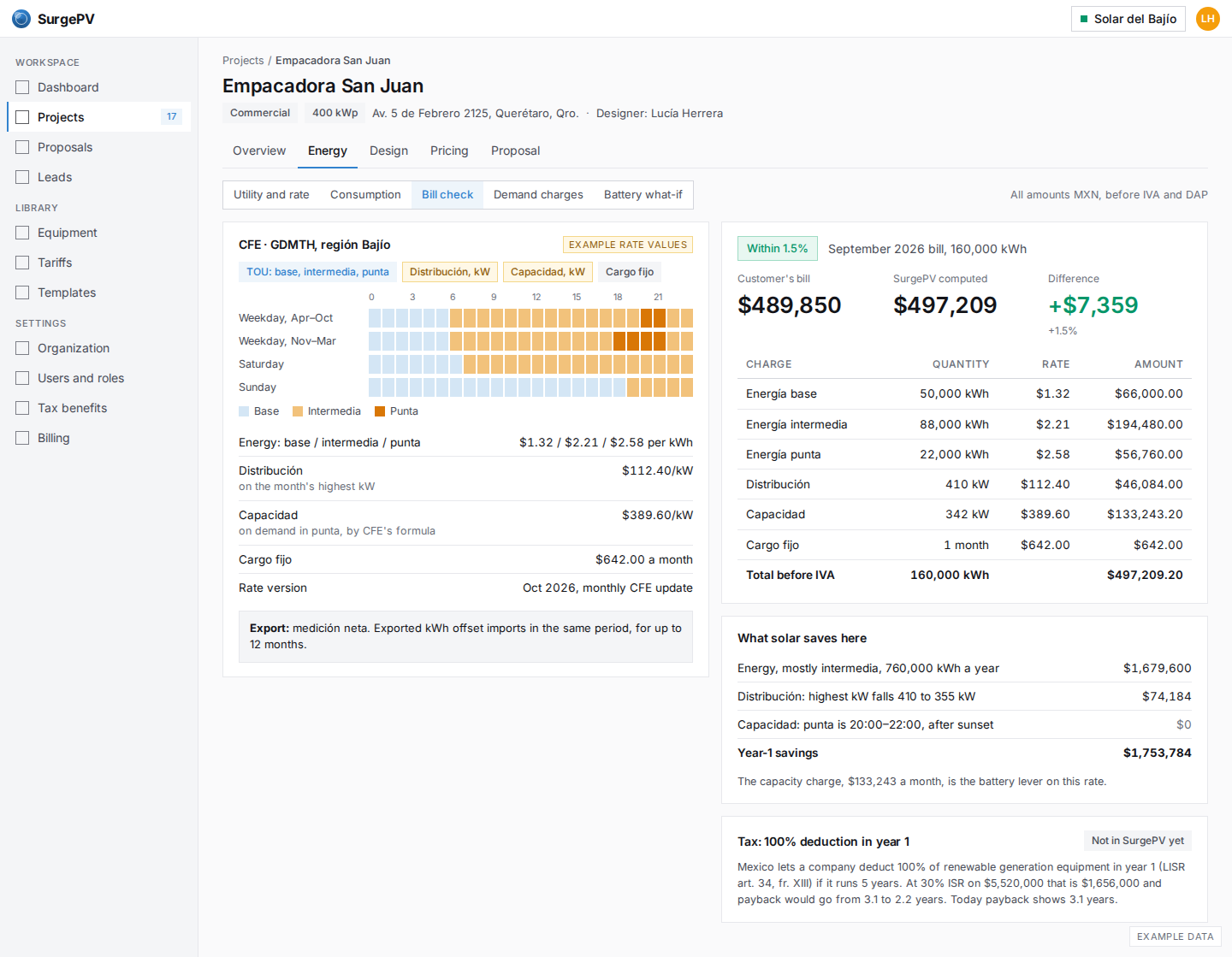
TB19
Mexico: CFE GDMTH
Empacadora San Juan in Querétaro on CFE GDMTH: base, intermedia and punta energy, a distribution charge and a capacity charge. The bill reproduces within 1.5%. Punta falls after sunset, so solar saves energy and some distribution, not capacity.